
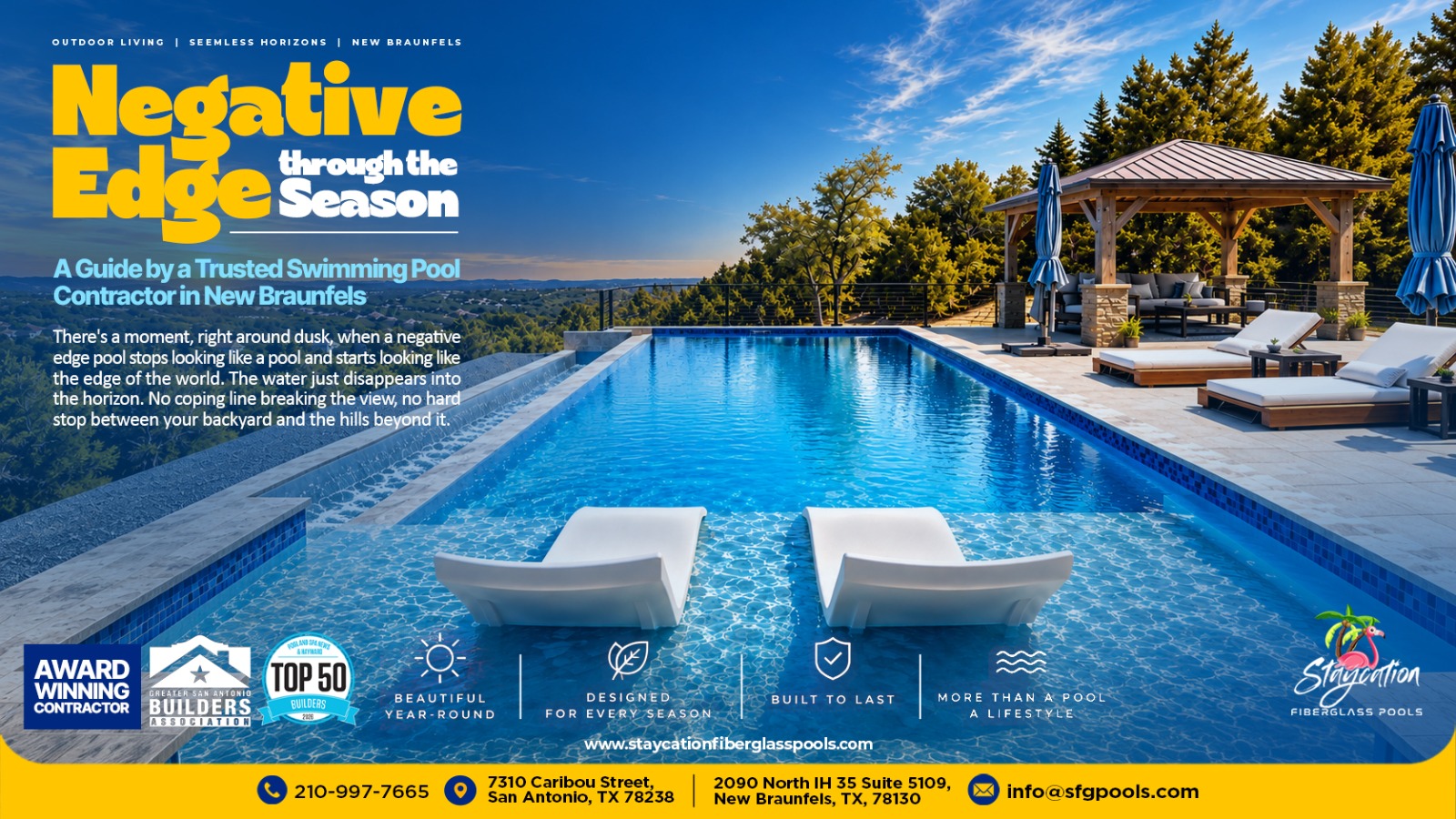
There’s a moment, right around dusk, when a negative edge pool stops looking like a pool and starts looking like the edge of the world. The water just… disappears into the horizon. No coping line breaking the view, no hard stop between your backyard and the hills beyond it.
If you’ve spent any time researching backyard upgrades, you’ve probably landed here because you’re weighing whether a negative edge (also called a vanishing edge or infinity edge) is worth it. As reliable swimming pool contractors in New Braunfels, we get asked this constantly, usually followed by “but does it still look good in January?” Good question. Let’s walk through it season by season.
A negative edge pool has one wall built lower than the rest, so water spills over it continuously into a hidden catch basin below. The pump recirculates that water back into the main pool, creating an endless, silent flow.
The effect is simple, but the engineering behind it isn’t. Getting that edge perfectly level, so the water sheets over evenly instead of pooling unevenly on one side, takes real precision. It’s one of the few pool features where a fraction of an inch actually shows.
Spring in the Hill Country is short but generous. Bluebonnets show up, the air softens, and everything outdoors suddenly feels worth sitting in.
A vanishing edge does something particular in this season. Since the water’s surface stays so still along the spill line, it picks up reflections better than a standard pool does. Wildflower fields, budding oak canopies, even a passing cloud, all of it shows up twice: once in the sky, once in your water.
Homeowners who’ve had their pools finished by early spring often share how this is when they first “get” why choosing a vanishing edge was the perfect decision in the first place.
Texas summer heat isn’t subtle, and neither is how it changes a pool’s personality. Evaporation picks up, the water warms faster, and everyone in the house suddenly wants to be near it after 6 p.m.
This is peak negative-edge season for a simple reason: golden hour light hits that spill line and turns it into a moving ribbon of gold. It’s the kind of detail that doesn’t photograph as well as it feels in person.
However, as a pool owner, these few practical notes can help you out:
Fall is the quiet season for pools, and honestly, it might be the most underrated one. The light gets lower and warmer, humidity drops, and the water surface calms down without the wind gusts that spring sometimes brings.
Moreover, fall isn’t just the prettiest season for a negative edge, it’s also one of the most practical ones. A few reasons homeowners tend to enjoy this stretch the most:
Have you noticed your own pool acting differently once the temperature drops? It’s worth paying attention to this time of year, since fall often reveals exactly how well an edge was engineered in the first place.
Yes, and it might be the season most homeowners underestimate.
This area doesn’t see the kind of deep freezes that force pools into full hibernation. With proper equipment protection, an infinity edge can keep running through winter, and there’s something genuinely striking about steam lifting off warm water into cold morning air, right at that vanishing point.
Fiberglass pool design options hold up especially well here. The gelcoat surface resists the freeze-thaw cracking that can stress out plaster or gunite finishes over time, which matters a lot on an edge wall that’s engineered to razor-thin tolerances.
Not every pool shell handles a negative edge gracefully. Fiberglass has a few built-in advantages worth knowing about before you commit to a design.
Yes. Fiberglass shells are manufactured off-site under controlled conditions, so the spill wall arrives pre-formed and consistent, rather than being hand-shaped on location.
Fiberglass material also resists algae growth better than plaster surfaces, which keeps that reflective, glass-like water quality easier to maintain year-round.
So where does that leave you if you’re actually shopping designs? A couple of manufacturer lines worth putting on your radar:
The better fit usually comes down to your lot size, how you plan to actually use the space, and how much of that “resort quietness” versus “moving water sound” you’re after.
Negative edges aren’t a DIY-adjacent feature, and they’re not really a “pick any builder” feature either. Grading, drainage, and catch-basin placement all have to work together perfectly. Hill Country lots often throw in slopes and soil conditions that complicate things further. One miscalculation on the spill wall, and the whole illusion falls apart.
This is where experience actually shows. A few things worth checking before you sign anything:
At the end of the day, a negative edge is only as good as the hands that built it. So when you’re comparing the swimming pool builders this area has to offer, let the finished pools do the talking.
This pool style isn’t just a design flourish. It’s a way of turning an ordinary backyard into something that feels like it belongs on a hilltop resort, in every season the Hill Country throws at it.
If you’re picturing that view from your own patio, Staycation Fiberglass Pools has spent years building exactly this kind of feature for homeowners across the New Braunfels area. As a trusted swimming pool contractor, our team can walk your property, talk through what a fiberglass negative edge would look like on your specific lot, and help you figure out if this upgrade is the right choice for you.
Recent Articles




Popular Tags